
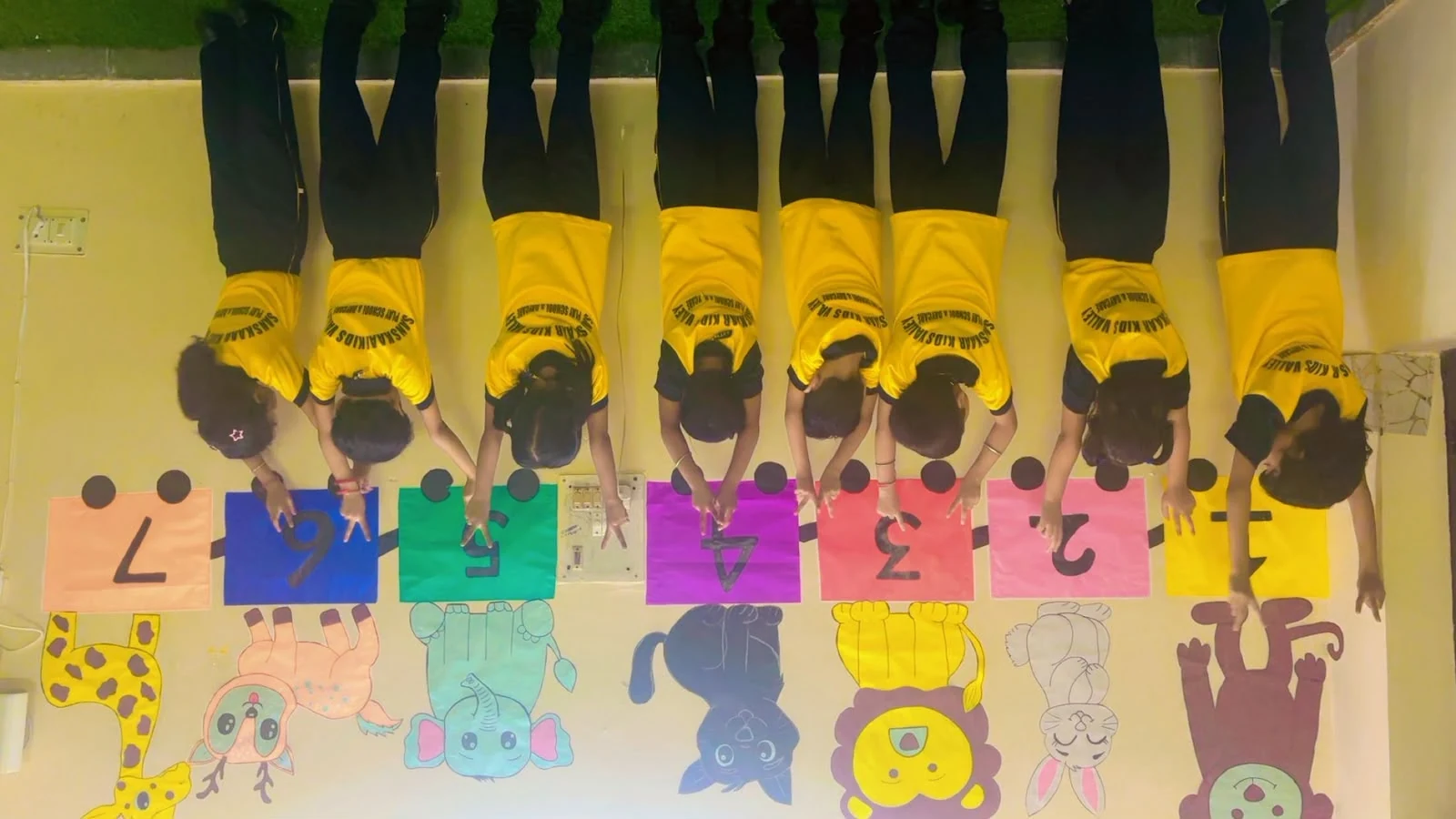
"He holds the pencil wrong." It is one of the most common worries parents bring to a preschool, and it is almost always solved by looking at the hand rather than at the pencil. Holding a pencil properly is the last step in a long sequence of small muscle skills, and if the earlier steps are shaky, the grip will be too.
How pencil grip actually develops
- Around 18 months to 2 years: holds a crayon in a whole-fist grip and scribbles with the whole arm moving, not the wrist.
- Around 2 to 3 years: the grip comes down to the fingers, the arm starts to stay steadier, and the child can copy a rough vertical and horizontal line.
- Around 3 to 4 years: copies a circle, draws a person as a head with legs, and starts using one hand consistently. Scissors begin to work with help.
- Around 4 to 5 years: copies a cross and a square, draws a person with several parts, and can grip a pencil with three fingers - the tripod grip.
- Around 5 to 6 years: writes some letters and numbers, cuts along a line, and can write their own name.
Read that list again and notice where the pencil appears: right at the end. Everything before it is preparation. A four year old with a fist grip is not being stubborn; they are usually still working on the strength and control that come before the tripod hold.
Signs the hand needs more work
- Avoids drawing, puzzles and threading, and says "I can't" quickly
- Swaps hands constantly past four, or still uses a whole-fist grip at five
- Tires after two minutes of colouring, or presses so hard the paper tears
- Struggles to open a tiffin box, do up velcro, or screw a lid
- Avoids messy play and dislikes the feel of dough, sand or paint on the hands
- Uses the whole body to move the pencil instead of the wrist and fingers
Two or three of these together is worth practising at home and mentioning to the teacher. One of them on its own is usually just age.
Twenty activities that build the hand
All of these use things most homes already have, and none of them involves a workbook.
- Kneading and rolling dough or atta
- Poking dried rajma or chana into dough
- Threading pasta or beads onto a string
- Tearing paper into strips, then into small pieces
- Crushing and pasting bits of paper for a collage
- Squeezing a sponge in a bowl of water
- Transferring water with a spoon, then a dropper
- Picking up small items with a clothes peg
- Peeling and sticking stickers - cheap and extremely effective
- Sorting coins, buttons or rajma into bowls with thumb and forefinger
- Screwing and unscrewing lids and jars
- Turning pages of a book one at a time
- Drawing with chalk on the floor or a wall board
- Painting with thick brushes, then thin ones
- Finger painting and printing with vegetable halves
- Cutting strips of paper with child-safe scissors
- Rolling and flattening dough with a rolling pin
- Stacking and balancing small blocks
- Helping in the kitchen - shelling peas, tearing spinach, mixing
- Buttoning, zipping and velcro practice on their own clothes
Fifteen minutes a day, in the form of play, is enough. Not all of them, and not in a set order - just keep something in the child's reach and let them choose.
How to help with grip without nagging
- Give small tools. Short, thick crayons and chunky chalk naturally force the fingers into a better position than long thin pencils.
- Draw on a vertical surface. Paper taped to a wall or a board on the floor makes the wrist work at a better angle than a flat table.
- Let them use one hand. Children usually settle into a preferred hand between three and five. Do not force a right-handed grip on a left-handed child - writing left-handed is not a problem.
- Correct gently and rarely. A quick "hold it like this" once a day is fine. Repeating it every thirty seconds makes children stop drawing, and a child who stops drawing loses far more than a grip.
- Do not use a grip-correcting device on a child under five unless a professional has recommended it for a specific reason.
- Remember the goal is willingness, not neatness. A child who draws happily with a chunky grip at four will very likely hold the pencil correctly at five. A child who is corrected into disliking drawing will not.
Rule of thumb for parents: if your child can open their tiffin, do up velcro, squeeze dough and thread a bead, the hand is developing on schedule. The pencil will follow.
What preschool adds
A good preschool day is full of fine motor practice without ever calling it that - dough, threading, beading, painting, tearing, pasting, pouring water, buttoning on and off for dress-up. If you want to see whether a school really does this, ask what the children did with their hands today, and see whether the answer includes more than worksheets.
If your child is past five and still cannot use scissors or hold a pencil at all, or if you see a strong dislike of all hand activities alongside other difficulties, mention it to your paediatrician - an occupational therapist can assess and help, and early input is much easier than later correction.
Sanskaar Kids Valley builds these activities into the day through art and craft, sensory play and hands-on discovery. Ask the team what your child is working on - call or WhatsApp 9990280330, or read more about the learning approach and why play matters more than workbooks.