
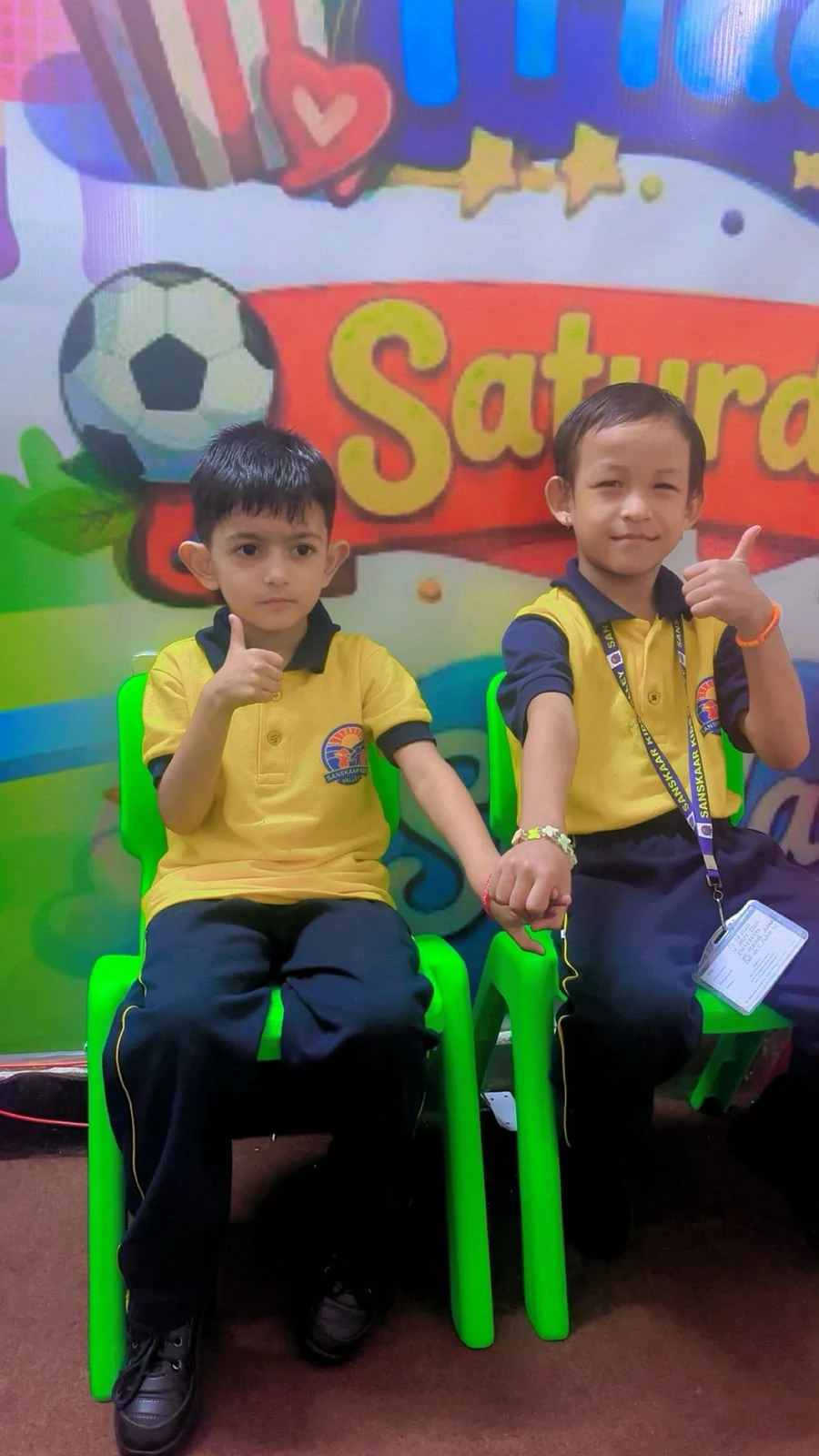
Every parent of a three-year-old has had this morning: a child who cannot find the blue sock, who is now on the floor, and who is beyond reasoning. Nothing about that moment is a failure of discipline. It is a nervous system that has not yet learned to manage a big feeling - and that skill, unlike letters and numbers, is mostly taught by what we do in exactly those moments.
What social-emotional learning actually is
It is five ordinary skills:
- Noticing feelings - in yourself and in other people
- Naming them - "I am angry", "I am scared", not just "I am screaming"
- Managing them - a way to come back down that the child controls
- Getting along - taking turns, joining play, disagreeing without hitting
- Making a choice - deciding to wait, to share, or to ask, rather than to grab
None of this is a subject taught at 10 am on Tuesdays. It is learned in the middle of ordinary conflicts, repeatedly, for years.
Why it matters more than letters right now
A child who can say "I want a turn" gets further in a preschool classroom than a child who can recite the alphabet but pushes. It is also the foundation for everything academic later: a child who cannot tolerate frustration will not persist with a hard puzzle, and a child who cannot ask an adult for help will sit silently and stop trying. In the Foundational Stage framework, social-emotional development is given real weight alongside language and number sense.
Name the feeling out loud, constantly
This is the single highest-value habit, and it costs nothing.
- "You are disappointed because the tower fell."
- "You look worried about the dog."
- "I am feeling tired and grumpy right now."
- "Look at his face - he is sad because his drawing got torn."
Children who hear feelings named learn to name them, and a named feeling is already a step down from a meltdown. Books are the easiest place to practise: pause on the page and ask what the character is feeling.
Validate, then set the limit
All feelings are allowed. Not all behaviour is. The formula is two parts, said in this order:
"You are very angry that we have to leave the park. It is hard to stop when you are having fun. We are still going home now - you can be angry about it while we walk."
This does two things at once. It tells your child that the feeling is understood and not dangerous, and it tells them that the limit is not negotiable. Saying "don't cry, it's nothing" removes the first part and leaves the child to fight for the second.
Teach a calming strategy - while calm
Children cannot learn a new skill in the middle of a storm. So practise the tools at a neutral moment, make them physical and name them, and then remind your child to use one during a small upset - not the biggest one.
- Big breaths. "Smell the flower, blow the candle" works better for a three-year-old than "take a deep breath".
- Counting down together from five, slowly.
- A squeeze. Hug a cushion, press palms together, or push against a wall.
- A quiet corner. Not a punishment chair - a place with a cushion and a book where a child can choose to go and settle.
- Water. A drink or washing hands genuinely interrupts a spiralling cry.
Teaching three or four of these and using them yourself - out loud, so your child sees it - is what makes them available in a real moment.
Sharing: the honest version
Genuine sharing is not developmentally expected before about three, and it is shaky until four or five. Asking a two year old to share is asking for something their brain has not built yet. What you can do instead:
- Practise turns, not sharing. "It is his turn, then it is your turn." Turn-taking is concrete and learnable; sharing is abstract.
- Use a timer for the much-wanted toy. Two minutes each. The toy stops being a fight and becomes a clock.
- Protect one or two special things. A favourite blanket or a new toy need not be shared with a visitor. That is reasonable for adults too.
- Praise the behaviour you want to see. "You gave her the red car - she looks happy" teaches more than a lecture about kindness.
- Do not force an apology. A forced "sorry" teaches a word, not a repair. Better: "Look, she is crying. Let us ask if she is okay."
When your child hits or bites
It happens in most homes and it is not a sign of a bad child or bad parenting. What to do in the moment, in order:
- Stop the behaviour immediately and calmly, with your body - move between the children, hold the hand.
- Attend to the child who was hurt first. This shows where the priority lies, and it removes the audience for the behaviour.
- Name the feeling and the limit together. "You were angry because he took your car. I will not let you hit."
- Keep it short. A long lecture teaches nothing to a child whose nervous system is still flooded.
- Repair afterwards, not during. Once everyone is calm: "What can we do to make him feel better?"
- Look for the pattern. Most hitting happens when a child is tired, hungry, overstimulated or in a crowd. Fixing the trigger works better than punishing the act. See Sleep and School.
Habits that quietly backfire
- "Don't cry", "big boys don't cry", "there is nothing to be scared of." These teach a child to hide feelings rather than handle them.
- Punishing the emotion - sending a crying child to their room for crying.
- Distracting with a phone every time feelings rise. The child never practises coming back down on their own.
- Inconsistency. The same behaviour being fine on Friday and a crisis on Monday is what makes limits feel unsafe.
- Sarcasm and shaming, especially in front of others. It works in the short term and costs a great deal later.
- Parents modelling the opposite. Children copy how we handle our own frustration far more than what we tell them about theirs.
At school
Group settings give children hundreds of small social problems to solve daily - which is exactly what makes preschool so valuable. Teachers do not remove conflict; they coach through it. If your child is going through a hitting or biting phase, tell the teacher so you are both working the same way rather than both inventing different rules. See How to Talk to Your Child's Preschool Teacher.
Sanskaar Kids Valley treats social learning as part of the day rather than a separate lesson. If you would like to talk through how your child is getting on with other children, call or WhatsApp 9990280330, or start on the Admissions page.